Go-to-Market (GTM) strategies are frequently discussed by companies of all sizes and market values, emphasizing their universal relevance in business. So, what exactly is a GTM strategy, and why is it critical to grasp, consider, and implement?
J.P. Eggers famously described a GTM strategy as “the difference between hope and a plan.” This encapsulates the essence of GTM as not just a series of hopeful outcomes but as a structured, strategic approach.
A GTM strategy is a blueprint a company uses to introduce its product or service to the market and effectively reach its intended customers. It includes a detailed plan that covers the decisions, steps, and activities necessary to market and sell a product or service successfully. Additionally, it addresses the risks involved in the process and outlines strategies to mitigate them, ensuring a smoother path to market entry and commercial success.
To guarantee the effectiveness of your GTM strategy, it’s essential to set precise goals and determine metrics to monitor your progress. Key performance indicators (KPIs) are critical for evaluating how well your strategy is working. Some vital KPIs to consider include customer acquisition cost, conversion rates, market share, revenue growth, customer retention, and customer satisfaction.
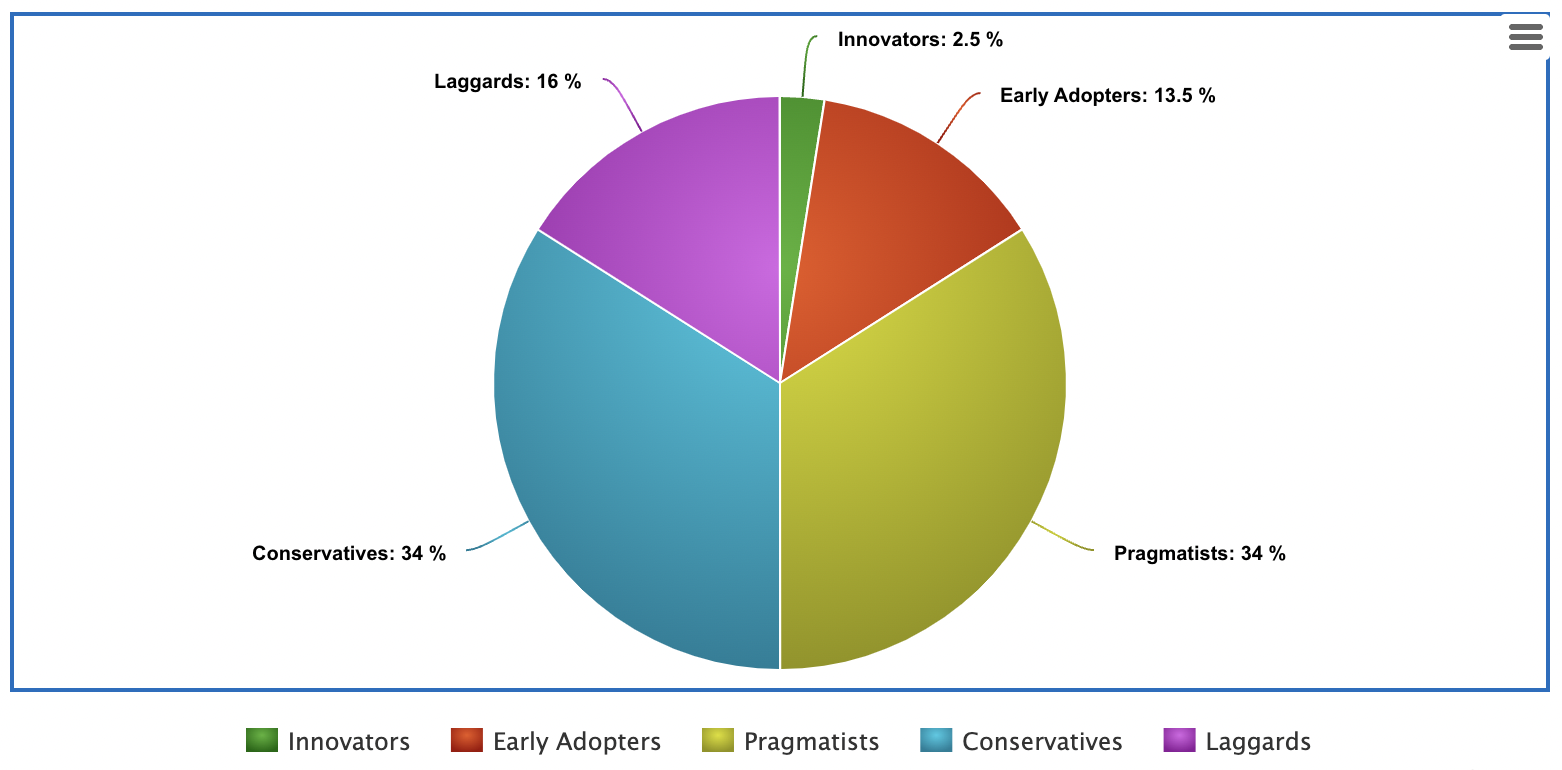
Who is your target market? How can you be sure they will purchase your product or service? Let’s take a moment to understand the average percentage of consumer’s mindset and identify where we should concentrate our sales efforts.
-
Innovators: These are the 2.5% of buyers who are the ultimate tech geeks. They don’t just use technology; they could marry it if it were legal. Always first in line for the latest gadget, they thrive on being the guinea pigs for new ideas. You want someone to test-drive your product and give brutally honest feedback? Look no further. But be warned, their loyalty is as fleeting as their attention span—they might ditch you for a newer, shinier model faster than you can say “software update.”
-
Early Adopters: Representing a quirky 13.5% of the market, these folks are like the cool kids at the tech prom—they believe in new ideas and are eager to dance with success. They’re on the lookout for real proof that the next big thing isn’t just a bunch of smoke and mirrors. Eager to roll up their sleeves, they’ll jump right into co-creating the solution, partly because it makes them look super innovative. And yes, they’re the type to let a few things slide, always cheering on the actual innovators, even if it means a little compromise on their part.
-
Pragmatists: Ah, the Early Majority, making up a whopping 34% of the market. These folks are the steadfast “show-me-the-proof” types. They aren’t about taking leaps of faith; they want cold, hard evidence that what they’re buying isn’t going to explode in their faces. Think of them as the “trust but verify” crowd. They don’t do risky business or compromise—they want everything to be as secure as a squirrel’s nut in winter. If you can get glowing reviews and enthusiastic thumbs-ups from earlier customers, these pragmatists might just be persuaded to jump on your bandwagon.
-
Conservatives: Welcome to the Late Majority club, where 34% of the market clings to the good old days like a cat to a warm laptop. These folks aren’t big on change; they’d rather stick with the devil they know than dance with the devil they don’t. Following market leaders? Absolutely. If it’s not broke (or even if it is), they don’t want to fix it. For them, sticking to the old ways is like comfort food—it just feels right, even if it’s not the best thing on the menu.
-
Laggards: Then there’s the Laggards, making up 16% of the market, who only shop when their backs are against the wall. These are the ultimate skeptics, viewing every innovation like it’s a UFO sighting—interesting but highly suspect. They buy new technology like they’re picking up broccoli at the store; they know it’s good for them, but they’re not happy about it.
In your GTM strategy, aiming for Innovators and Early Adopters is like lining up the cool kids at a party. They’re the pioneers who’ll grab your product first and start the buzz. Winning them over isn’t just good luck; it’s laying the golden bricks on the yellow brick road to mass acceptance. Every little step with them counts, and these baby steps pave the way to your victory dance!
And once you hit that sweet spot of Product-Market Fit—boom, you’re not just guessing anymore. You’ve got cold, hard proof that the market is practically waiting for what you’re serving. Now’s the time to pump up the volume and scale, riding that wave of early success into the sunset.
Slack’s GTM
Let’s talk about Slack & how they pulled a successful Go-to-Market (GTM) strategy. Slack’s success story with its GTM is a classic example of innovative marketing and adept market positioning.

Here’s how Slack pulled off a GTM strategy that made it a powerhouse in the realm of team communication tools in past decade:
Starting with a Strong Product: Slack began as an internal tool developed by the company Tiny Speck, while they were working on a different project (an online game called Glitch). Slack was designed to solve a specific problem: improving communication among the development team. The tool was so effective that they decided to pivot and launch Slack as a standalone product.
Beta Testing and Feedback Loop: Before public launch in August 2013, Slack had an extensive beta phase during which they invited users, friends, associates to try the product and provide feedback. This not only helped refine the product but also created a buzz around it. Slack keenly incorporated user feedback, which helped in fine-tuning its features to exactly what teams needed. Some users went ahead and shared on their twitter too.
Word-of-Mouth and Organic Growth: Slack’s initial growth was largely fueled by word-of-mouth. They focused on providing an exceptional user experience that naturally encouraged users to share it with others. Slack’s design emphasized simplicity and usability, which helped it stand out from more complex tools. I’d dub it “Gossip Growth.” There was a flurry of articles touting Slack as the “Email Killer.” It was a brilliant PR move, setting the stage with headlines that made everyone sit up and take notice.


Focusing on Specific Market Segments: Slack strategically targeted Silicon Valley tech companies, where they knew the demand for efficient communication tools was high. By capturing the tech niche, Slack leveraged the influence and visibility of this sector to gain wider market attention.
Freemium Model: Slack adopted a freemium model that allowed teams to use a limited version of the software for free indefinitely. This low barrier to entry encouraged adoption, and as organizations grew dependent on the tool, they moved to paid plans for additional features.
Viral Marketing Tactics: Slack used clever marketing tactics that encouraged viral loop. This makes product cost effective and trustworthy. For example, they made it easy for individuals within organizations to start using Slack and then naturally expand to more teams and departments.
Strong Branding and Communication: Slack’s branding was strong, quirky, and human. They focused on being more than just a tool; they aimed to be a part of the team culture. Their communications and marketing were straightforward and often humorous, which made them memorable and relatable.
Continuous Improvement and Integration: As Slack grew, they continued to add new features and integrations with other tools. This made Slack more indispensable as it could serve as a hub for all workplace communications and integrations.
Data-Driven Scaling: Slack kept a close eye on usage data to understand how people used their product and to identify pain points. This data-driven approach informed their product development and marketing strategies, ensuring they were always improving and evolving based on user needs.
From the outset, Slack focused on the details. Alongside offering an effective freemium product, the company leveraged both organic and paid word-of-mouth marketing to build trust, establish credibility, and attract customers. Their dedication to customer-centric support played a pivotal role in cultivating deep customer loyalty
Through these strategic moves, Slack not only managed to introduce a new product into the market successfully but also to sustain its growth and become a fundamental tool for teams worldwide, demonstrating the power of a well-executed GTM strategy.
Embracing a Go-to-Market strategy isn’t just a business move; it’s the blueprint for marketplace victory. From igniting the spark with Innovators to stoking the flames with Early Adopters, and securing steadfast support from Pragmatists, your GTM plan is your road map from obscurity to ubiquity. Through humor, strategy, and real-world success stories like Slack, we’ve navigated the nuances of market entry. Remember, the key to conquering market challenges lies not just in crafting a solid plan but also in adapting and evolving it to meet the shifting sands of consumer expectations and technological advancements. So, strategize wisely, monetize your efforts, and enjoy the journey to market mastery!